“Food noise” refers to the constant, intrusive thoughts about food that can show up even when you’re not physically hungry. It’s the mental chatter – what to eat, what not to eat, how many calories something has, whether you’ve been ‘good’ or ‘bad’.
These thoughts can feel relentless. For many of my clients, food takes up far more mental space than they want it to. And often, they don’t realise just how much it’s draining their energy, focus, and emotional wellbeing.
Imagine this… It’s 3:30pm.
You’ve just finished a meeting and sat down to tackle your overflowing inbox – but your minds already wandered. Biscuits. You remember the half-open packet in the cupboard.
You ate lunch. You’re not physically hungry. But the thought keeps returning – persistent, insistent.
You try to distract yourself, sip your tea, get back to the task at hand. But it’s still there: Just one won’t hurt… Maybe with a coffee… That’s too many calories… I’ll focus better after… No, I shouldn’t – biscuits are bad.
Within minutes, you’re standing in the kitchen, reaching for the packet. You eat quickly, barely tasting them, guilt creeping in before you’ve even swallowed the last bite.
This is food noise – the relentless mental chatter about food that can leave you feeling out of control, ashamed, or exhausted.
At Kate Wall Nutrition, I work with people who feel addicted to food, anxious around eating, or stuck in exhausting cycles of guilt, restriction, and bingeing. Often, they don’t realise how much food noise is draining their energy or impacting their relationship with food. It takes real mental effort to manage that internal dialogue day after day.
This blog builds on last month’s post about weight loss medications. These drugs have been reported to reduce food noise in some people, highlighting just how significant a barrier it can be to sustainable eating. But these drugs are not suitable for everyone, and you can’t be on them forever.
So: what is food noise? Why does it affect some people more than others and what can you do to quiet it, compassionately and sustainably?
What is food noise?
The Science behind food noise
This experience isn’t “just in your head”, it’s actually rooted in a real psychological and biological response called food cue reactivity.
We evolved to be highly responsive to food cues in our environment – it helped keep us alive when food was scarce. But now, in a world filled with food marketing, diet rules, and emotional overwhelm, that system can get overstimulated.
Extensive neural circuitry in the brain dictates the motivational responses elicited by food cues such as sight, smell, and sound. These motivational responses manifest as food cravings and can be disconnected from a physiological need for food based on hunger, leading to food-seeking behaviour.
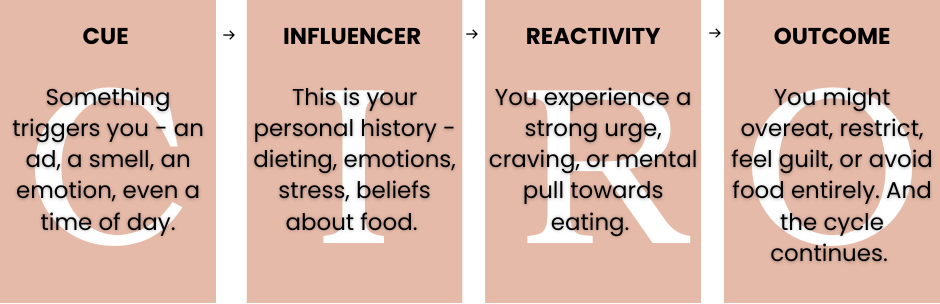
Researchers describe this process using the CIRO model, which explains how food noise can build up over time:
Examples of food noise in everyday life
The Afternoon Biscuit Spiral
Emma’s not physically hungry- she had lunch at 13:00 – but as soon as she sees someone else dunking a biscuit into their tea, the thought lodges in her mind. Within minutes, she’s standing in the kitchen, telling herself “I’ll be good tomorrow” as she polishes off four biscuits, barely tasting them. She feels out of control and ashamed, but also emotionally ‘comforted’- a short-term relief with a long-term cost.
- Cue: The sight of a colleague eating a biscuit on a Zoom call.
- Influencer: A long history of “being good” all day and then giving in by 3pm, plus a belief that “I shouldn’t snack.”
- Reactivity: Sudden craving, mind fixates on the cupboard; internal script: “I’ve blown it now.”
- Outcome: Eats several biscuits quickly, feels guilt, promises to skip dinner—starting the cycle again tomorrow.
The Emotional Cue at Night
For Emily, food noise kicks in after the kids are in bed. She heads to the fridge, even though dinner wasn’t that long ago. The food isn’t about fuel; it’s comfort. It’s a cue from her brain saying “I need something.” But that “something” is rarely just food.
- Cue: Feeling lonely and tired at the end of the day.
- Influencer: Years of associating food with comfort (from childhood) + stress from parenting and work.
- Reactivity: Craving cheese, crackers, wine – not out of hunger, but to self-soothe.
- Outcome: Eats mindlessly in front of the TV, then wakes up the next day feeling bloated and disappointed in herself.
The ‘Good/Bad’ Food Trap
Jake isn’t even a huge chocolate fan, but ever since he started a new diet that bans it completely, he can’t stop thinking about it. As soon as he sees it by the till, his brain lights up-“Just this once, I’ve earned it”. The first bite feels like relief. The last bite feels like shame. He’s not addicted to chocolate, he’s stuck in a reaction loop that’s being amplified by restriction.
- Cue: Seeing a bar of chocolate at the petrol station.
- Influencer: A recent diet plan that forbids chocolate and labels it as “bad.”
- Reactivity: Increased craving because it’s been labelled off-limits; internal tension rises.
- Outcome: Buys two bars, eats one in the car quickly, and feels disgusted with himself – reaffirms the “I have no willpower” belief.
These examples show that food noise is not about lack of discipline-it’s the brain responding to powerful cues filtered through past experience, emotional context, and internalised beliefs and this is why some people are more sensitive to cues than others, due to genetics, trauma, dieting, or emotional factors. The CIRO model helps explain it, but it’s in these everyday stories that people truly feel it.
If this sounds familiar, you’re not alone, and it’s not your fault. Food noise is complex and layered. But the good news is, it can be understood, and more importantly, it can be quietened -without extreme diets or shame.
Food Noise vs Physical Hunger: How to tell the difference?
Understanding the difference between food noise and physical hunger is a vital step in building a healthier relationship with food. Many of the people I work with feel overwhelmed or confused, “Am I actually hungry, or just thinking about food again?”
What Is Food Noise?
To recap; food noise is the mental chatter about food that shows up when your body may not actually need fuel. It’s often tied to emotions, routines, or habits rather than genuine hunger.
This is a form of cue reactivity, as we discussed earlier. The thought is often louder, more urgent, and more emotional than physical hunger.
What Is Physical Hunger?
Physical hunger is your body’s way of saying it needs energy. It builds gradually and can often be satisfied by a balanced meal, not just one specific food.
Typical signs of physical hunger:
- Stomach rumbling or emptiness
- Low energy, irritability, or trouble focusing
- A willingness to eat a wide range of foods, not just specific craving
How to Tell the Difference
Try asking yourself these questions in the moment:
| Question | If the answer is “yes” … | If the answer is “no” … |
| Would I eat a proper meal right now? | Likely physical hunger | Possibly food noise |
| Did the craving come on suddenly? | Possibly food noise | More likely true hunger |
| Is there a specific food I must have? | Likely emotional/food cue | Physical hunger tends to be more flexible |
| Do I feel it in my stomach, or just in my head? | Stomach = hunger | Head = noise |
Why It Matters
Understanding this distinction isn’t about ignoring your cravings or “being strong.” It’s about tuning into your body’s real needs – whether that’s fuel, rest, connection, or comfort. When you learn to pause and ask, “What do I really need right now?”, you start to build trust with yourself – and loosen food’s emotional grip.
Why Some People Experience More Food Noise Than Others
If you’ve ever wondered “Why can’t I stop thinking about food when others seem fine? –you’re not alone, and there’s a good reason for it.
Food noise doesn’t affect everyone in the same way. For some people, it’s an occasional background hum. For others, it’s constant and overwhelming -like a radio that never switches off. Understanding why this happens can help you respond with more compassion, not more control.
Dieting and Food Restriction
One of the strongest triggers for food noise? Trying not to eat.
The moment you start telling yourself certain foods are off-limits; your brain can become hyper-alert to them. The more you restrict, the more intense the thoughts often become.
“I work with many clients who say they felt more obsessed with food when they were trying to diet than when they allowed themselves to eat more freely.”
Genetics and Brain Chemistry
Some people are biologically more sensitive to food cues.
- You might have a stronger dopamine response to highly palatable foods (think: crisps, chocolate, pastries).
- You might also have inherited patterns of emotional regulation that make you more likely to use food for comfort or stimulation.
- People with ADHD, binge eating disorder, or trauma histories may experience more intense food noise due to how their nervous systems respond to cues.
Emotions and Unmet Needs
Food often steps in as a coping tool.
- Stress, anxiety, loneliness, or boredom can all act as internal cues that make your brain search for relief.
- When food has historically been a source of comfort, distraction, or reward, your brain will keep returning to it-even when you’re not hungry.
“I often ask clients not just what they’re craving, but what they’re feeling when the craving shows up. That shift alone can bring powerful insight.”
Constant Exposure to Food Cues
We live in a world designed to keep food on our minds:
- Social media full of recipe reels, “What I Eat in a Day” videos, and transformation posts
- Food ads on TV, podcasts, bus stops
- The ‘treat drawer’ at work, or the smell of baking from a shop
This 24/7 exposure keeps our brains in a state of heightened food cue reactivity, especially when we’re tired, stressed, or emotionally vulnerable.
A History of Disordered Eating or Food Guilt
If you’ve ever experienced:
- binge–restrict cycles
- guilt after eating
- labelling food as “good” or “bad”
…you may be more vulnerable to food noise. Why? Because your brain starts attaching intense emotional meaning to food – eating becomes a moral or emotional event, not just a physical one.
This creates a feedback loop where:
- You try to be “good” → you obsess more → you eat → you feel guilt → you try to restrict again → the food noise gets louder.
You’re Not Failing—Your Brain Is Responding as Designed
Food noise isn’t a sign of failure, lack of discipline, or addiction. It’s your brain reacting to a complex mix of biology, emotion, history, and environment.
And the good news is—it can change. With the right support and strategies, you can begin to quiet that noise and rebuild trust with your body.
How Food Noise Affects Your Relationship with Food and Well-being
Food noise isn’t just annoying. When it becomes constant, it can deeply affect how you feel about food—and yourself. It’s not just the thoughts themselves that are exhausting; it’s the emotional and behavioural ripple effects they create.
Emotional Toll: Guilt, Shame and Anxiety
Many people describe food noise as a relentless inner dialogue:
“Should I eat that? Have I eaten too much? I’ll start again tomorrow… I’ve ruined it now…”
Over time, this mental chatter leads to:
Guilt after eating
Shame about cravings
Anxiety about social meals or eating in front of others
It can start to feel like food is controlling you, rather than the other way around.
“I hear from so many clients that they’re tired of thinking about food all day. They just want peace—but they don’t know how to get there.”
Behavioural Patterns: Binge, Restrict, Repeat
When food noise gets loud, it can drive reactive behaviours like:
Mindless snacking or late-night eating even when not hungry
Binge episodes followed by restriction
Avoiding meals, social events or certain foods for fear of losing control
Ironically, the more you try to “be good,” the more intense the noise can become-leading to another cycle of frustration, guilt and compensatory behaviour.
Cognitive Load: Constant Mental Drain
Food noise takes up a surprising amount of mental space. When you’re preoccupied with food:
- Decision-making becomes harder.
- Focus and productivity dip.
- You may feel irritable or distracted—even if you’re physically full.
It’s like having a constant background app draining your mental battery.
“It’s not just the eating- it’s thinking about eating all day that’s exhausting.”
Impact on Self-Esteem and Body Image
Persistent food noise can erode confidence and fuel negative body image. You might begin to believe:
“I have no willpower.”
“I can’t be trusted around food.”
“There’s something wrong with me.”
This inner narrative can affect everything from your mood and motivation to your social life and self-worth.
For many people, reducing food noise is not just about nutrition—it’s about reclaiming emotional energy, restoring balance, and finding peace with food.
It’s about breaking the cycle, building self-trust, and learning how to respond rather than react.
The Rise of Food Noise in the Media: Why We’re Talking About It Now
In recent years, the term food noise has gained traction in the media – especially in conversations about weight loss medications like semaglutide (sold as Wegovy or Ozempic).
Many people using these medications report a dramatic reduction in food thoughts:
“It’s like someone turned down the volume in my brain.”
“I don’t think about food all the time anymore.”
“I can finally eat when I’m hungry and stop when I’m full.”
This effect has brought food noise into the spotlight- helping to validate what so many people have experienced, often in silence. It’s no longer framed as a lack of willpower, but a neurological and psychological pattern that can be shifted.
But Medication Isn’t the Whole Story
While GLP-1 medications can reduce food noise for some, they’re not suitable or accessible for everyone, and they’re not a long-term solution on their own. Most people will come off them eventually, and unless the underlying patterns and triggers have been addressed, food noise may return.
That’s why understanding what drives your food noise, and learning how to manage it through sustainable strategies, is just as important – whether you take medication or not.
Reducing food noise is not just about having more willpower – it takes awareness, compassion, and evidence-based tools. Here are three small but powerful places to start:
- Limit food cue exposure
Declutter your space, mute food-heavy accounts on social media, and create regular, flexible meal patterns to reduce unstructured grazing.
- Practice mindful eating
Bring attention to your meals. Slow down, notice flavour and fullness, and avoid moral language around food (“good” vs “bad”).
- Pause before reacting
Ask yourself: “What do I really need right now?” Is it food? Rest? Reassurance? Even a short pause can break the automatic cycle.
Want a full toolkit of strategies to help reduce food noise?
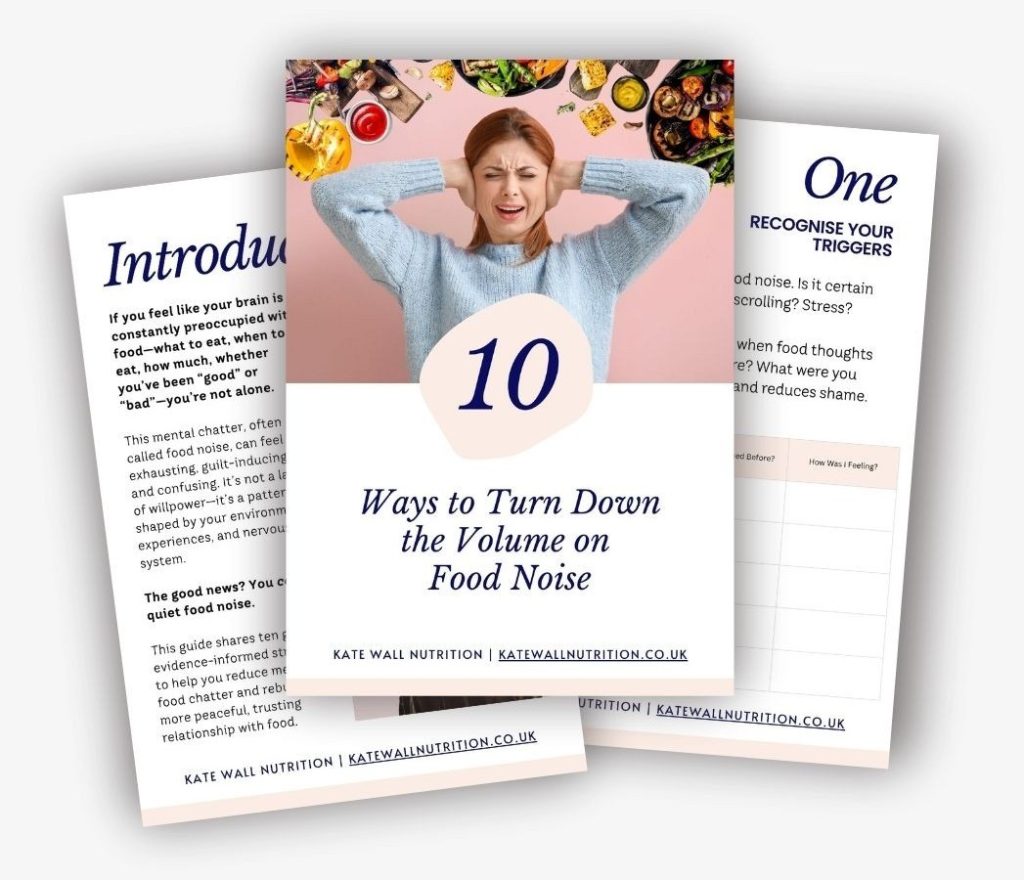
Download my free guide: “10 Ways to Turn Down the Volume on Food Thoughts”
Rebuilding Your Relationship with Food: My Approach
The work I do at Kate Wall Nutrition is about more than food. It’s about creating space for understanding, safety, and change. I help clients:
- Identify their personal food cues and emotional drivers
- Unpick guilt, restriction, and food fear
- Develop flexible food routines that support both nourishment and enjoyment
This is not about perfection. It’s about quieting the noise so you can focus on the things that matter most in life
Final Thoughts
If food noise is taking up too much space in your mind, know that it’s not your fault—and you’re not alone.
There are practical, compassionate ways to turn down the volume. Whether you’re on medication, navigating food guilt, or just looking for clarity, you can rebuild your relationship with food and reconnect with your body’s wisdom.
And if you’d like support on that journey, I’m here to help.
📘 Download my free guide: 10 Ways to Turn Down the Volume on Food Thoughts
Or, if you’d prefer personalised support, get in touch to book a free discovery call – I’d love to help you find clarity, confidence, and peace around food.
Disclaimer: The information in this blog is for general information only and should not be used as individual advice. Advice may vary for certain medical conditions and the information in this article is not intended to replace or conflict with the advice given to you by your GP or other health professionals. All matters regarding your health should be discussed with your GP. If you or someone you know may be suffering from an eating disorder, then please seek professional help.